



China Top Orthopedic Implant Materials Suppliers?
China’s orthopedic manufacturing sector serves a broad market, from trauma plates and screws to hip and knee components. But choosing a supplier is not just a price comparison. The performance of orthopedic implant materials depends on composition, processing, surface finish, and how each product is tested. A polished sample can look reassuring. It is not enough.
Biomaterials expert David F. Williams defines a biomaterial as “a material intended to interface with biological systems to evaluate, treat, augment or replace any tissue, organ or function of the body.” That definition highlights the real challenge: an implant material must work in contact with living tissue, not merely meet a sales specification. For buyers reviewing Chinese suppliers, useful questions include whether material grades are traceable, test records are available, and manufacturing controls are clearly documented. Ask how titanium alloys, cobalt-chromium alloys, stainless steels, or polymer components are handled, where relevant to the product range.
Small details matter. A certificate alone may not explain a process change, a batch variation, or the limits of a test. Supplier comparisons should therefore consider technical documentation, quality systems, production capability, and communication—not price alone. This guide outlines practical ways to assess China-based orthopedic implant materials suppliers and prepare informed questions for further review. It cannot replace independent technical or regulatory assessment. And some supplier information may be incomplete; that deserves careful follow-up, not an easy assumption.
Orthopedic Implant Materials Used in China
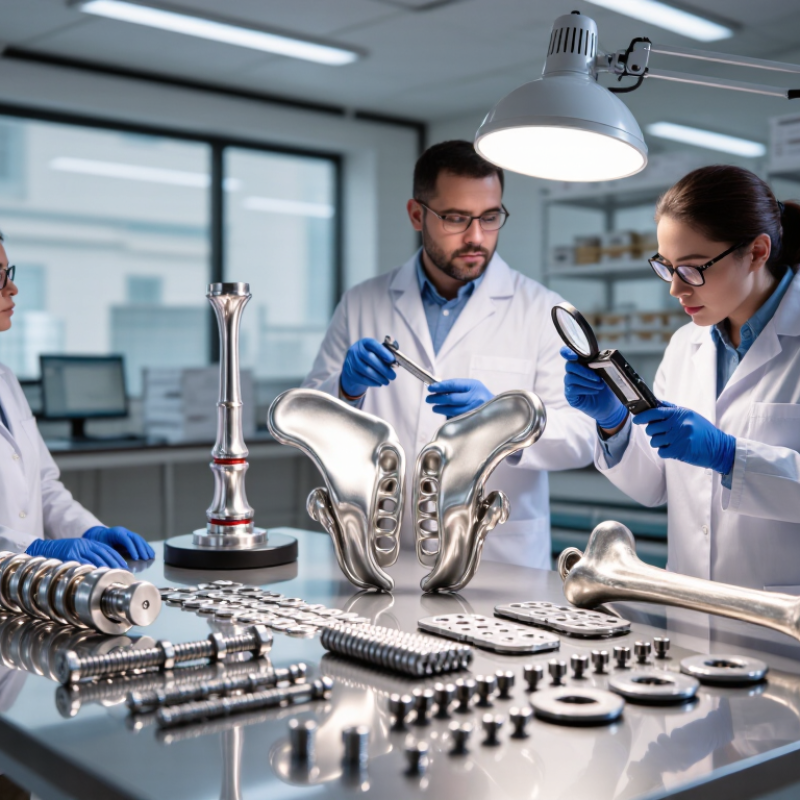
China’s orthopedic implants commonly use titanium alloys, cobalt-chromium alloys, stainless steel, ceramics, and ultra-high-molecular-weight polyethylene. Each serves a different mechanical role. Titanium alloys are valued for strength and relatively low weight, while cobalt-chromium alloys can suit high-wear joint surfaces. Ceramic components offer another bearing option. Polyethylene often forms the cushioning surface in joint replacements. The choice depends on anatomy, load, wear, and the implant design—not simply on which material sounds strongest.
The ISO 5832 series sets technical requirements for metallic implant materials, including titanium and cobalt-based alloys. It is a useful reference, but compliance alone does not prove that every device performs equally in a patient. Grand View Research’s China orthopedic implants market report estimated the market at about US$3.9 billion in 2023; this is a market estimate, not a breakdown of material use. That distinction matters. In practice, surgeons and engineers weigh imaging, bone quality, expected activity, and revision options. A ceramic-on-polyethylene pairing may reduce certain wear concerns, yet no material removes risk. Small details matter. Surface finish, sterilization, and manufacturing consistency can affect outcomes, and public material-share data for China remain limited. That gap deserves more scrutiny.
How China’s Orthopedic Materials Supply Chain Is Organized
China Top Orthopedic Implant Materials Suppliers?
How China’s Orthopedic Materials Supply Chain Is Organized
China’s orthopedic materials supply chain usually spans several specialized stages. Upstream producers supply titanium alloys, stainless steel, cobalt-chromium alloys, polymers, and ceramic materials. Processors then convert these inputs into bars, sheets, forgings, or powders suited to specific manufacturing methods. Material certificates and batch records help buyers trace where each lot came from.
Implant makers typically handle precision machining, finishing, cleaning, and assembly, while qualified service providers may perform surface treatments or sterilization. Distributors connect manufacturers with hospitals, but their role varies by region and product category. The chain is not always tidy: one supplier may provide material, while another performs a critical process. That makes clear documentation essential. Buyers can review applicable quality-system records, material test reports, process controls, and product-specific evidence rather than relying on a supplier’s broad claims.
Tips: Ask for the material grade, lot traceability, and test results. Check who performs each outsourced step. Confirm that records match the product and intended use. A polished sample is not enough. Small gaps in documentation deserve follow-up.
Key Criteria for Comparing Chinese Implant Material Suppliers
When comparing Chinese orthopedic implant material suppliers, begin with the intended application, not the lowest price. Titanium alloys, cobalt-chromium alloys, and stainless steels have different mechanical and processing characteristics. Ask for current material specifications, chemistry results, mechanical test data, and certificates linked to specific production lots. A certificate alone is not enough; confirm that its details match the material and process you plan to purchase. Small details matter.
Review how the supplier controls production, inspection, and changes to materials or processes. Request examples of traceability records and ask how deviations are investigated and documented. If possible, assess the facility or arrange an independent quality review. Compare lead times, minimum order quantities, packaging, and the responsiveness of technical staff. A quick quote can hide slow document support. Sample testing is useful, but it cannot replace ongoing process controls. No scorecard is perfect. I would still question any supplier whose answers sound polished but lack dated records, clear test methods, or named responsibilities. Reliable comparisons depend on evidence you can verify, not promises alone.
China Orthopedic Implant Material Suppliers: Key Comparison Criteria
Indicative Young’s modulus ranges for commonly used implant materials. Material properties help frame a supplier comparison, but do not represent the performance of any specific supplier.
When evaluating suppliers, also verify the applicable ASTM or ISO standard, material certificates, lot traceability, testing practices, and consistency between production batches. Actual properties vary by grade, processing, and product form.
Leading Chinese Suppliers and Their Material Specialties
Chinese orthopedic implant suppliers generally fall into two groups: material producers and implant manufacturers. Material producers may specialize in implant-grade titanium alloys, such as Ti-6Al-4V, or cobalt-chromium-molybdenum alloys used in joint components. Some also supply medical stainless steel for selected fixation applications. Ask whether the supplier controls composition, cleanliness, and batch traceability. Small variations matter.
Implant manufacturers often focus on converting these materials into plates, screws, spinal devices, or joint-replacement components. Their capabilities may include precision machining, forging, surface finishing, and inspection. A supplier’s material specialty does not automatically prove expertise in every implant type. Request test reports for the exact material grade and product, not a general catalogue sheet. Look closely at fatigue data, dimensional checks, and how surface treatments are documented.
Polymers deserve separate attention. Ultra-high-molecular-weight polyethylene is common in bearing surfaces, while PEEK may be used in selected spinal applications. Ask how the supplier verifies consistency between batches and manages changes in processing. A polished sample is not enough. Visit the production site when possible, and review quality records with a qualified technical team. I would not rank suppliers by material claims alone; public information can be incomplete, and comparisons are not always straightforward.
China Top Orthopedic Implant Materials Suppliers? - Leading Chinese Suppliers and Their Material Specialties
An anonymized overview of material categories available from China-based orthopedic implant material suppliers. This is not a named-company ranking; standards and suitable forms depend on the specific product and manufacturing process.
| Supplier material segment | Typical material specialty | Common orthopedic applications | Example material standards | Useful supplier checks |
|---|---|---|---|---|
| Titanium alloy stock suppliers | Ti-6Al-4V ELI in bar, rod, plate, or other qualified forms | Bone screws, plates, spinal fixation components, and other load-bearing implants | ASTM F136; ISO 5832-3 | Confirm grade, product form, chemistry, mechanical properties, traceability, and inspection records. |
| Commercially pure titanium suppliers | Unalloyed titanium in grades and forms selected for the intended implant process | Dental and orthopedic components, including selected plates, meshes, and fixation parts | ASTM F67; ISO 5832-2 | Check grade-specific limits, surface condition, dimensional tolerances, and lot documentation. |
| Cobalt-chromium alloy suppliers | CoCrMo alloys supplied as cast or wrought material, depending on the application | Selected joint-replacement components and other implants requiring wear resistance | ASTM F75 for cast alloy; ASTM F1537 for wrought alloy; ISO 5832-4 for cast alloy | Verify the alloy specification matches the manufacturing route and intended finished component. |
| Implant-grade stainless steel suppliers | Low-carbon, implant-grade stainless steel in qualified wrought forms | Selected trauma fixation devices, including plates, screws, and wires | ASTM F138; ISO 5832-1 | Confirm material condition, corrosion-related requirements, cleanliness, and full heat-to-lot traceability. |
| Medical PEEK suppliers | Unfilled or specially formulated polyether ether ketone for implant applications | Selected spinal and orthopedic components, including interbody devices | ASTM F2026 | Check formulation, processing history, biocompatibility evidence, and suitability for the intended sterilization method. |
| UHMWPE suppliers | Ultra-high-molecular-weight polyethylene in specified powder or finished forms | Bearing components and liners used in selected joint-replacement systems | ISO 5834-1; ISO 5834-2 | Ask about material grade, processing controls, oxidation-related testing, and applicable finished-product validation. |
| Tantalum material suppliers | High-purity tantalum and, where qualified, porous tantalum forms | Selected porous orthopedic components designed for bone-contact applications | ASTM F560 for tantalum; confirm the applicable specification for the supplied form | For porous products, verify pore structure, mechanical properties, manufacturing controls, and product-specific validation. |
Note: A material standard alone does not establish that a finished implant is approved or suitable for a particular use. Confirm current standard editions, regulatory documentation, and device-specific requirements with the supplier.
Supplier Verification, Quality Standards, and Procurement Considerations
China’s orthopedic implant suppliers should be assessed by product, process, and evidence—not by catalog size. Fortune Business Insights’ Orthopedic Implants Market report estimated the global market at USD 48.57 billion in 2023. That figure describes demand, not supplier capability. Important distinction.
Request current quality-system certificates, their scope, and the issuing body’s accreditation details. Then compare material certificates with the implant’s specified alloy or polymer, such as titanium alloy or UHMWPE. For metal devices, review applicable ASTM material and test methods; ISO 13485 certification alone does not prove each product meets its specifications. Check lot-level traceability, nonconformance records, sterilization validation, and documented controls for design or process changes.
For Chinese suppliers, verify manufacturing and product registration through applicable official records, and confirm that approvals cover the exact device and intended market. Audit the production floor: follow one sample lot from incoming material through machining, cleaning, packaging, and release. Ask for test reports from qualified laboratories, and confirm sample identifiers match production records. ISO 10993 biological evaluation may be relevant, but the required tests depend on contact type and duration. A polished audit file can still hide weak change control; inspect recent deviations and corrective actions. Supplier verification is never a one-time task.

