
Orthopedic implants are engineered devices that replace, support, or stabilize damaged bones and joints. Their purpose may sound simple. The clinical decisions are not. The World Health Organization estimates that about 1.71 billion people live with musculoskeletal conditions worldwide. This burden continues to increase demand for reliable reconstruction, fixation, and joint replacement technologies.
Industry data reflects this expanding need. Grand View Research valued the global orthopedic devices market at approximately USD 48.6 billion in 2022. Its report also projects continued growth through 2030, driven by aging populations, sports injuries, and improved surgical techniques. The American Academy of Orthopaedic Surgeons and national joint registries also emphasize careful implant selection, surgical accuracy, and long-term monitoring. These sources provide useful context, but market growth does not automatically prove clinical superiority.
Different orthopedic implants serve different anatomical problems. Joint replacement implants restore worn hips, knees, shoulders, or other joints. Trauma implants, including plates, screws, nails, and external fixation systems, stabilize fractures during healing. Spinal implants support alignment and decompression procedures. Smaller devices may assist ligament repair or bone reconstruction. Materials also vary, including titanium alloys, cobalt-chromium alloys, ceramics, and high-performance polymers such as PEEK. Fit matters. So does biology. The categories overlap, and no implant is perfect for every patient. A durable design can still fail when bone quality, alignment, infection risk, or rehabilitation is overlooked. Understanding these implant types requires both engineering knowledge and clinical judgment. The sections ahead examine their applications, materials, benefits, limitations, and selection considerations.
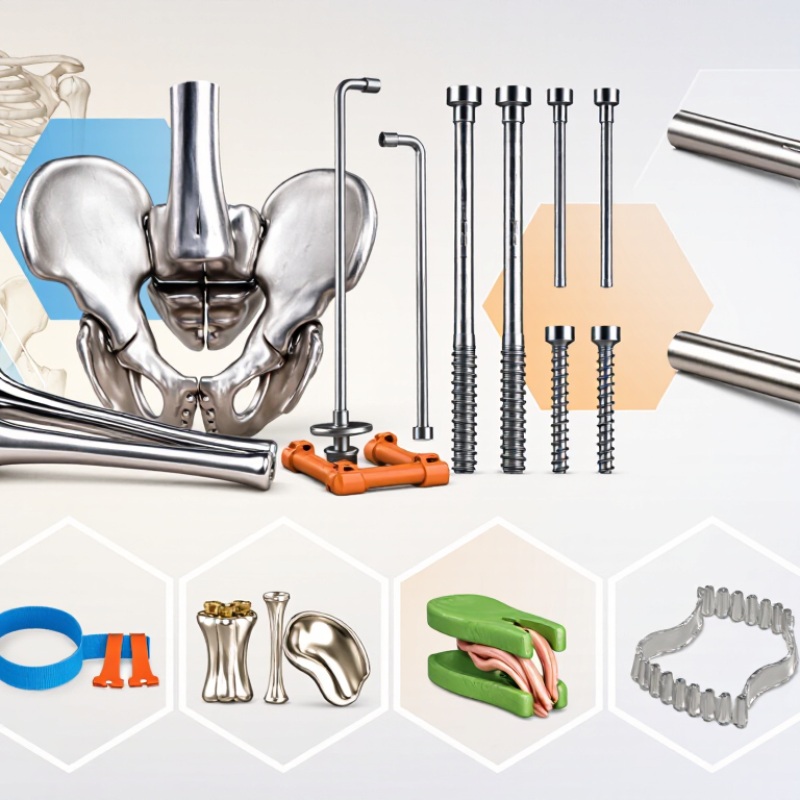
Orthopedic implants are medical devices placed in or on the body to support, repair, or replace damaged musculoskeletal structures. They may stabilize a broken bone, restore a worn joint, or guide spinal movement. Some implants remain permanently. Others are removed after healing. Classification helps doctors compare their purpose, design, and expected lifespan.
One common classification groups implants by body location. Joint implants replace parts of the hip, knee, shoulder, or other joints. Trauma implants include plates, screws, pins, and intramedullary nails for fractured bones. Spinal implants may include cages, rods, and fixation screws. Soft-tissue devices, such as suture anchors, secure tendons or ligaments to bone.
Implants can also be classified by material, fixation method, and duration of use. Common materials include titanium alloys, stainless steel, cobalt-chromium alloys, ceramics, and medical polymers. Some devices rely on screws or cement for fixation. Others encourage bone growth around their surfaces. Material choice depends on anatomy, bone quality, activity level, allergies, and imaging needs. A classification chart cannot capture every patient. The categories often overlap, which can create confusion. In clinical practice, surgeons review imaging, medical history, infection risk, and expected recovery before selecting an implant. Careful follow-up remains important because pain, loosening, wear, or delayed healing may appear gradually.
| Classification Dimension | Implant Type | Primary Purpose | Common Anatomical Applications | Typical Materials | Fixation or Attachment Method | Key Characteristics |
|---|---|---|---|---|---|---|
| By clinical function | Joint replacement implants | Replace damaged joint surfaces and restore movement when a joint is severely affected by arthritis, fracture, or other disease. | Hip, knee, shoulder, ankle, elbow, and selected finger joints. | Titanium alloys Cobalt-chromium alloys Stainless steel Ceramics Ultra-high-molecular-weight polyethylene | Cemented, cementless press-fit, or hybrid fixation, depending on the joint, bone quality, and surgical plan. | Usually consists of multiple components that articulate against one another and are selected according to anatomy, activity level, and bone condition. |
| By clinical function | Bone fixation plates | Stabilize fractured or osteotomized bone fragments while healing occurs. | Forearm, wrist, ankle, leg, shoulder, pelvis, and other long or irregular bones. | Titanium alloys Stainless steel Cobalt-chromium alloys | Attached to bone with screws; some plates use locking screw interfaces. | Available in compression, locking, reconstruction, buttress, and anatomically contoured designs. The choice depends on fracture pattern and bone anatomy. |
| By clinical function | Bone screws | Hold bone fragments together or secure plates, grafts, and other fixation devices. | Nearly all regions requiring fracture fixation, including the hand, foot, spine, pelvis, and long bones. | Titanium alloys Stainless steel Biodegradable polymers | Threaded directly into bone; may be cortical, cancellous, cannulated, locking, or bioabsorbable. | Design features include thread profile, diameter, length, head shape, and compression capability. Selection is based on bone density and the required stability. |
| By clinical function | Intramedullary nails and rods | Provide internal alignment and load-sharing stabilization for fractures of long bones. | Femur, tibia, humerus, and selected forearm fractures. | Titanium alloys Stainless steel | Inserted into the medullary canal and commonly secured with locking screws at one or both ends. | Can support early weight-bearing in appropriate cases. Nail diameter, length, curvature, and locking configuration are important design factors. |
| By clinical function | Spinal implants | Stabilize the spine, restore alignment, decompress neural structures when necessary, or support spinal fusion. | Cervical, thoracic, lumbar, and sacral regions. | Titanium alloys Polyether ether ketone Cobalt-chromium alloys Bone graft materials | May include screws, rods, plates, interbody cages, hooks, or other fixation components. | Implant selection varies with spinal level, surgical approach, bone quality, deformity, instability, and whether fusion is planned. |
| By clinical function | External fixation components | Stabilize fractures or deformities from outside the body while limiting disturbance to injured soft tissues. | Complex limb fractures, open fractures, pelvic injuries, bone lengthening, and temporary stabilization. | Stainless steel Titanium alloys Carbon-fiber composite | Pins or wires pass through the skin into bone and connect to external bars, rings, or frames. | Can be temporary or definitive. Pin-site care and monitoring for infection are important parts of treatment. |
| By clinical function | Tendon, ligament, and soft-tissue anchors | Reattach tendons or ligaments to bone during repair or reconstruction. | Shoulder, knee, hip, ankle, elbow, hand, and foot. | Titanium alloys PEEK Bioabsorbable polymers Sutures | Inserted into prepared bone tunnels or surfaces and secured with sutures or fixation elements. | May be metallic, polymer-based, or designed to gradually resorb. Size and placement depend on tissue strength and repair technique. |
| By clinical function | Bone graft substitutes and void fillers | Fill bone defects and provide a scaffold or material that may support new bone formation. | Spine, pelvis, long bones, foot, ankle, and areas affected by trauma or bone loss. | Calcium phosphate Calcium sulfate Demineralized bone matrix Porous metals | Placed directly into a bone defect, sometimes together with plates, screws, cages, or other fixation devices. | Properties differ in porosity, resorption rate, handling, and biological activity. They do not all provide structural support by themselves. |
| By material composition | Metallic implants | Provide high strength and structural support for fixation or joint reconstruction. | Fracture fixation, joint replacement, spinal stabilization, and trauma reconstruction. | Titanium alloys Stainless steel Cobalt-chromium alloys Tantalum | Attached with screws, cement, press-fit surfaces, or integrated components. | Different alloys vary in stiffness, corrosion resistance, wear behavior, strength, and imaging characteristics. |
| By material composition | Polymer implants | Provide lightweight structural support, insulation, spacing, or fixation with properties that differ from metals. | Spinal cages, suture anchors, joint-bearing components, fracture fixation accessories, and selected surgical devices. | PEEK Polyethylene Polyurethane Bioabsorbable polymers | May be secured by press-fit, screws, sutures, cement, or integration with another implant. | Some polymers are radiolucent or partially radiolucent, which can assist imaging assessment, while radiopaque markers may be added for positioning. |
| By fixation strategy | Cemented implants | Use bone cement to fill the space between the implant and prepared bone and provide immediate fixation. | Most commonly used in selected joint replacement procedures. | Metal components Ceramic components Bone cement | Anchored with polymethylmethacrylate bone cement rather than relying primarily on bone ingrowth. | May be considered when immediate fixation is important or when bone quality is reduced. Surgical indications vary by joint and patient. |
| By fixation strategy | Cementless or press-fit implants | Achieve initial mechanical stability and allow bone to grow onto or into a prepared implant surface. | Hip and knee replacement, trauma fixation, and selected reconstructive procedures. | Titanium alloys Cobalt-chromium alloys Porous metals Ceramics | Stabilized by interference fit, screws, porous coatings, or a combination of these methods. | Successful fixation depends on implant design, bone quality, surgical technique, loading, and the body's bone-healing response. |
| By intended duration | Permanent implants | Remain in the body for long-term structural support or joint function. | Joint replacements, spinal fixation, fracture plates, screws, and intramedullary nails. | Titanium alloys Stainless steel Cobalt-chromium alloys Ceramics PEEK | May be fixed with cement, screws, press-fit surfaces, bone ingrowth, or combinations of methods. | Removal is not routinely required unless there is a clinical reason such as infection, pain, mechanical failure, or other complications. |
| By intended duration | Temporary or bioabsorbable implants | Provide support during healing and may be removed later or gradually broken down by the body. | Selected fracture repairs, soft-tissue fixation, pediatric procedures, and bone-graft applications. | Absorbable polymers Magnesium-based materials Calcium-based materials | Placed by screws, pins, anchors, plugs, or direct filling of a bone defect. | Material strength and degradation rate must match the healing process. Use is procedure-specific and requires appropriate clinical evaluation. |
| By design surface | Porous or bone-ingrowth implants | Encourage bone to grow into or attach to the implant surface for biological fixation. | Joint replacement, revision reconstruction, spinal surgery, and large bone-defect treatment. | Porous titanium Porous tantalum Porous ceramics | Usually combined with press-fit fixation, screws, or other methods that provide initial stability. | Pore size, porosity, surface architecture, and mechanical properties influence bone integration and load transfer. |