

Top Bagasse Sushi Tray Suppliers for Global Buyers
Choosing reliable Bagasse Sushi Tray suppliers requires more than comparing catalog prices. Global buyers must examine fiber quality, mold precision, food-contact documentation, and delivery consistency. A tray may look sturdy in a product photograph. Real testing reveals more. Rice moisture can soften weak corners, while soy sauce may expose poor grease resistance.
Ellen MacArthur, a leading circular-economy authority, has said, “We need to redesign the way we make and use products.” Her principle fits bagasse packaging closely. Sugarcane fiber can turn agricultural residue into useful food-service products, but responsible sourcing still matters. Buyers should request material specifications, independent test reports, and clear manufacturing details. Compostability claims need verification under recognized standards, not attractive wording alone.
Performance matters at the sushi counter. Lids should close without crushing rolls. Compartments should separate ginger, wasabi, and sauces. Stacks should remain stable during warehouse handling and long-distance transport. Suppliers also need practical answers about minimum order quantities, custom molds, carton strength, and seasonal capacity. Experience shows that the cheapest quotation may create higher costs through leakage, rejected shipments, or inconsistent dimensions.
Some assumptions deserve caution. Bagasse is not automatically perfect. Industrial composting access varies by market, and local disposal systems may not accept every certified product. This guide compares leading suppliers through a buyer-focused lens, combining technical evidence, production experience, and supply-chain reliability. The goal is simple: help global purchasers select a Bagasse Sushi Tray that performs well in real service, not merely on paper.
What Are Bagasse Sushi Trays and Why Are They Used?
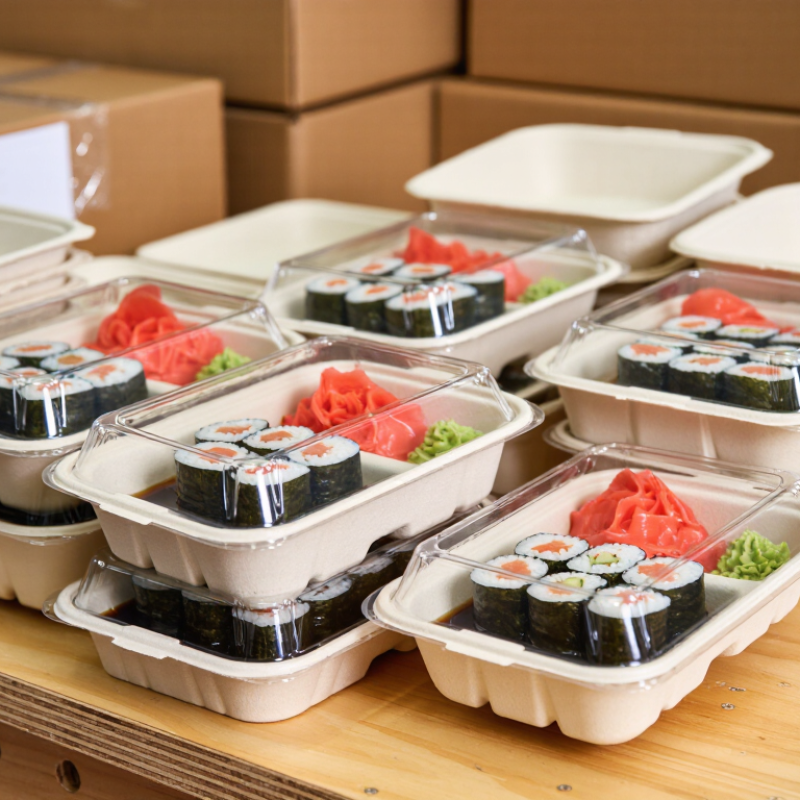
Bagasse sushi trays are molded-food containers made from sugarcane fiber. Bagasse is the dry residue left after juice extraction. FAOSTAT data places global sugarcane production near 1.9 billion tonnes annually. This creates a large agricultural by-product stream. Manufacturers clean, pulp, press, and heat the fiber into trays with shallow compartments. The result is a firm surface for sushi rolls, nigiri, and small side dishes.
These trays are used because they are lightweight, stackable, and suitable for chilled takeaway food. Many designs resist oil and moderate moisture without adding a plastic inner layer. That detail matters. The OECD’s Global Plastics Outlook reports that packaging creates about 40% of global plastic waste. Fiber trays can reduce reliance on conventional plastic packaging, but they are not automatically greener everywhere. Their impact depends on water use, additives, transport distance, and local composting facilities. A tray sent to landfill may offer fewer benefits than expected.
Tips: Check the tray’s food-contact documentation and moisture performance. Test rice, soy sauce, and refrigerated storage before bulk purchasing. Confirm whether local facilities accept molded fiber, since “compostable” labeling can be misunderstood. Buyers should also inspect tray edges, lid fit, and stacking pressure. Small defects become costly during international shipping. Industry forecasts from Smithers identify molded fiber as a continuing sustainable-packaging growth area, yet supplier claims still require independent verification.
What Are Bagasse Sushi Trays and Why Are They Used?
Bagasse sushi trays are molded-fiber food containers made from sugarcane processing residue. The chart shows common market formats used by foodservice buyers, organized by approximate sushi-piece capacity rather than by supplier or brand.
Smaller formats are commonly used for individual portions, while larger formats are selected for mixed assortments and takeaway sets. Actual dimensions and capacity vary according to sushi size, compartment design, lid clearance, and regional packaging specifications.
Key Features to Evaluate in a Bagasse Sushi Tray Supplier
Choosing a reliable bagasse sushi tray supplier requires more than comparing prices. The material should feel firm, clean, and dry, even when holding chilled sushi, sauces, or sliced vegetables. Ask about fiber sources, production controls, and food-contact testing. A dependable supplier should provide current documentation, batch details, and clear answers about additives or coatings.
Tray design also matters during real service. Check whether the lid closes securely, the compartments prevent movement, and the edges resist cracking. Request samples before placing a large order. Test them in refrigerators, delivery bags, and busy counter conditions. In my experience, a tray that looks strong online may bend when stacked. That small failure can damage presentation and increase waste.
Tips: Compare sample results, not only catalogs. Confirm dimensions, packing methods, minimum order quantities, and production lead times. Ask how defects are handled and whether replacement procedures are documented. Suppliers with stable quality records usually communicate more precisely. However, do not assume every certificate proves full reliability; verify its scope, date, and issuing body. Sustainability claims also need careful review, because “compostable” performance can depend on local facilities and conditions.
Leading Bagasse Sushi Tray Supplier Regions and Production Capabilities
Top Bagasse Sushi Tray Suppliers for Global Buyers
Leading bagasse sushi tray supplier regions differ in materials, equipment, and export experience. Southeast Asia has strong access to sugarcane fiber and established molded-pulp production. Many factories operate hot-press lines for stable tray shapes, clean edges, and consistent stacking. China offers broad tooling capacity and flexible order quantities. Some suppliers can develop custom compartments within several weeks, depending on mold complexity. India and parts of Latin America also provide growing bagasse resources and competitive labor costs. European and North American producers often focus on automated inspection, traceability, and strict food-contact documentation.
Production capability matters more than location alone. Experienced suppliers should control pulp moisture, pressing temperature, tray weight, and dimensional tolerance. These details affect sauce resistance and whether lids close properly during delivery. Ask for pilot samples using your actual sushi sizes. A tray may look excellent but bend under chilled food. No region is perfect. A rushed mold revision can create thin corners or uneven nesting, which increases waste and handling costs.
Tips: Check factory capacity, not just catalog photos. Request recent test reports, material specifications, and batch records. Confirm whether barrier treatment is compostable and suitable for your destination market. Review carton strength, pallet patterns, and lead times before approving mass production. Small trial orders reveal practical problems early. Suppliers may promise tight tolerances, but independent inspection remains worthwhile.
How Global Buyers Can Compare Quality, Certifications, and Pricing
Top Bagasse Sushi Tray Suppliers for Global Buyers
Global buyers should compare bagasse sushi trays through evidence, not attractive photos. Inspect tray walls, corners, and lid fit after refrigeration and stacking. Experienced buyers should request samples from the same production batch. This reveals warping, oil seepage, and weak hinges. Ask for pulp composition, food-contact test reports, and production dates. Independent migration testing should cover grease, moisture, and temperature conditions. Food-contact compliance may require FDA or European Union documentation, depending on the destination market. EN 13432 or ASTM D6400 can support compostability claims, but certification scope matters. A compostable tray is not automatically suitable for every disposal system.
Pricing needs a landed-cost view. Include tooling, freight, minimum order quantity, carton dimensions, and defect allowances. Grand View Research valued the global green packaging market at about 101.49 billion dollars in 2022. It projected a 7.5% annual growth rate through 2030. That demand can improve factory efficiency, yet it may also encourage vague sustainability claims. Compare prices per usable tray, not per carton. Request a written quote with moisture resistance, thickness, tolerance, and delivery terms. A cheaper sample may fail after cold storage. I have seen buyers overlook stacking space. That mistake becomes expensive. Supplier audits, batch records, and corrective-action procedures add confidence, although no factory performs perfectly every time.
Top Bagasse Sushi Tray Suppliers for Global Buyers - How Global Buyers Can Compare Quality, Certifications, and Pricing
| Supplier Category | Typical Bagasse Material | Quality Indicators to Verify | Food-Contact Documentation | Compostability Evidence | Typical MOQ | Indicative FOB Price* | Typical Production Lead Time | Customization Capability | Best Fit for Global Buyers |
|---|---|---|---|---|---|---|---|---|---|
| Standard Export Supplier | Molded sugarcane fiber; generally unbleached or lightly bleached; single-layer construction | Even molding, smooth rim, no visible cracks, stable stacking, consistent tray weight, acceptable odor level | Food-contact declaration; migration test report; raw-material statement; applicable destination-market compliance documents | Written industrial-compostability claim supported by test documentation; verify whether coatings and inks are included | 50,000–100,000 pieces | US$55–95 per 1,000 pieces | 20–35 days after artwork and specification approval | Stock sizes; simple embossing or one-color printing may be available | Price-sensitive distributors and standard sushi takeaway programs |
| Mid-Market Export Supplier | Molded bagasse fiber with improved density and moisture resistance; optional water-based barrier coating | Weight tolerance control, dimensional inspection, leak-resistance testing, compression testing, batch traceability | Food-contact declaration plus migration testing for the finished product; production hygiene records; batch documentation | Applicable industrial-compostability test reports for the finished tray, including coatings, labels, and adhesives where relevant | 30,000–80,000 pieces | US$80–135 per 1,000 pieces | 25–45 days after approval of the production sample | Custom tray dimensions, cavity layout, embossing, color printing, and retail packaging | Importers requiring a balance of cost, presentation, and compliance documentation |
| Premium Audited Supplier | High-density molded fiber with controlled wall thickness, tighter dimensional tolerances, and validated barrier options | Documented quality-management system, lot inspection, moisture and oil resistance testing, drop testing, pallet-load testing, corrective-action records | Current food-contact test reports for the finished article; traceability from fiber pulp to finished goods; factory audit records available on request | Recognized compostability certification or equivalent third-party evidence; confirm certification scope, certificate validity, and end-of-life conditions | 20,000–50,000 pieces | US$120–220 per 1,000 pieces | 35–60 days for tooling, validation, and first production order | Complex cavity designs, premium finishes, multi-color printing, barcode labels, and customized cartons | National foodservice chains, premium retailers, and buyers with formal supplier-audit requirements |
| Small-Batch Custom Supplier | Molded bagasse fiber based on existing tooling or short-run custom tooling; specification varies by design | Pre-shipment sample approval, basic dimensional checks, visual inspection, and confirmation of food-contact suitability | Request finished-product declarations and laboratory reports before purchase; documentation depth may vary by order size | Request evidence for the exact material formulation and coating; do not assume that all fiber trays are home compostable | 10,000–30,000 pieces | US$150–300 per 1,000 pieces | 30–60 days depending on tooling and artwork | High design flexibility; suitable for unusual dimensions, logo embossing, and limited-edition packaging | Restaurants, specialty retailers, and buyers testing a new sushi packaging concept |
Ordering, Customization, and International Shipping Considerations
Top Bagasse Sushi Tray Suppliers for Global Buyers
Ordering bagasse sushi trays requires more than comparing carton prices. Check fiber content, food-contact documentation, moisture resistance, and production consistency. The FAO reports that about 14% of food is lost between harvest and retail, so a tray should protect delicate sushi during handling. Ask suppliers for migration-test results, batch samples, and photographs of sealed cartons. Small details matter, especially when rice moisture softens weak edges.
Customization should begin with the sushi layout. A 6-piece tray needs different wells from a 12-piece set. Confirm internal dimensions, lid clearance, stacking height, and sauce-cup positions. Request a physical prototype before approving a mold. It costs more initially. Still, it can prevent thousands of unusable units. UNEP’s 2023 Turning off the Tap report says global plastic pollution could fall by 80% by 2040 through system changes, including reuse and alternative materials. Bagasse is not automatically sustainable; buyers should verify agricultural residue sourcing, additives, and local composting conditions.
International shipping needs practical planning. UNCTAD reports that over 80% of global merchandise trade by volume moves by sea. Confirm Incoterms, container loading plans, carton compression limits, and moisture barriers. Ask whether pallets comply with destination requirements, including ISPM 15 where applicable. Calculate landed cost, not factory price alone. Freight delays, port storage, and damaged cartons can change the result. A lower quote may be a false saving. I would also allow extra lead time; production schedules rarely behave perfectly.

